
Mallets or Blades?
Blurred Distinctions

I recently posted a comment I hope had some value in any evaluation of putter preference you might consider. You aim the look and swing the weight. For me, this premise begs the question, what defines the putter as a blade or a mallet? I have recently been involved in discussions where the putters were weighted as blades. The center of the putter head mass, close to the face, yet this weighting appeared in a mallet shape.
My reason for concern: Most putters are sold by what the recreational golfer sees on TV. Player X wins an important tournament with brand Z putter. So they make the change based on someone else’s success. What they don’t know is that Player X has a mallet weighted to match the putter he used to develop his skills.
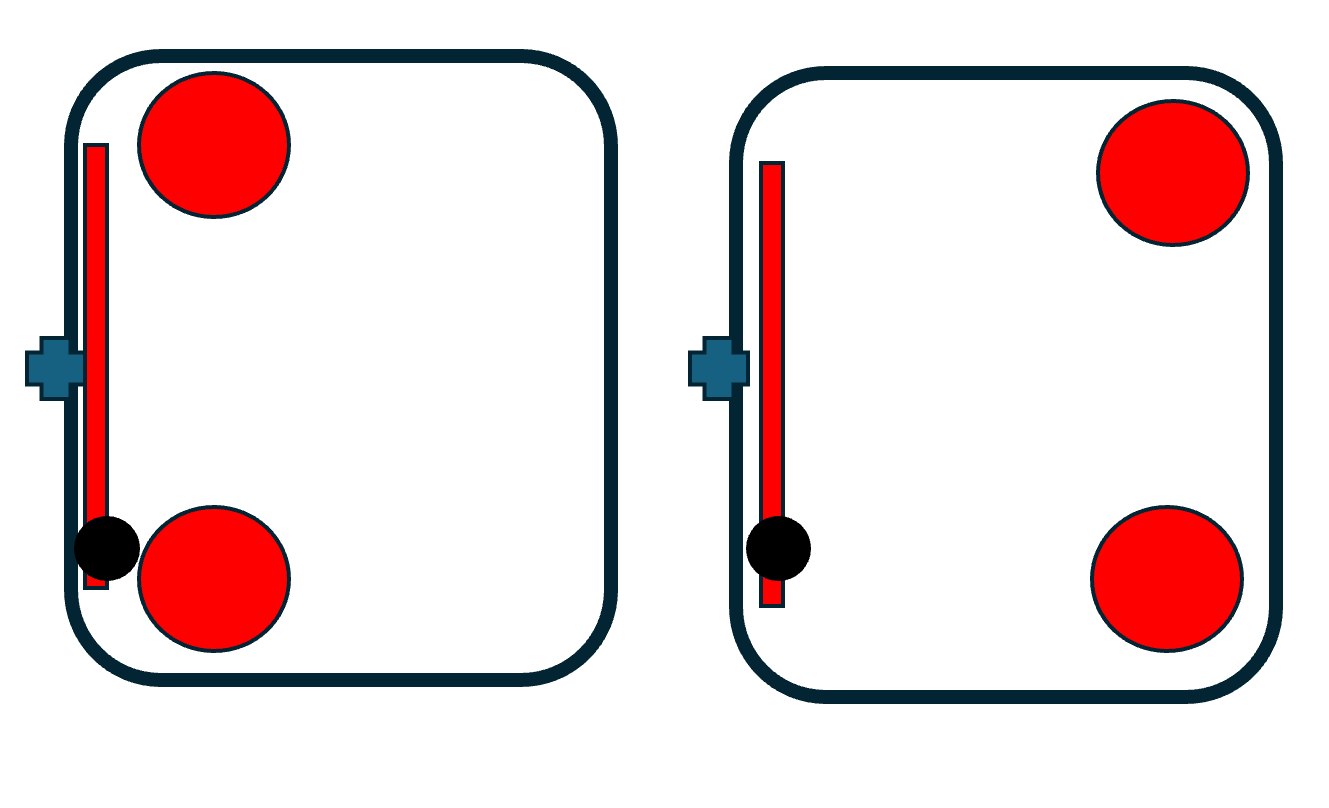
Consider the two weighting diagrams above. The Blue Cross is the location of shaft axis. The Black Circle is where the shaft attaches. the Red areas are concentration of weight. Ignoring any face balance description. which putter rotates more easily, like a blade design? Which might resist? Both have the same toe hang(another marketing term)! Yet one rotates more easily than the other. Now consider all you can see is the black outline. They might look exactly the same, but one is totally different than the other.
As you consider what works best for you, I offer the following considerations.
What is required of the putter for you to have an accurate perception of the start line? Line on the putter or no line? Big footprint or small? One quick suggestion as you consider this point: Framing the ball is not aiming the putter. We learned that the hard way during the 2-Ball era. Players thought if the two circles on the putter matched the ball on the ground, the face of the putter was going in the correct direction. That proved to not be true. Most, if not all, people who use that type of putter aimed left or to a pull side of the target line.
If our goal to putt better is to find consistent contact in the center of the face, what is the weighting requirement that best suits my stroke to achieve that goal? We have talked about this a great deal and will continue to in the future. For today, consider this: the center of mass in a putterhead is an average of the influence of the actual weight.
When you watch players on television, keep in mind that these players are coached to swing the putter in a manner that fits a deep cog, higher MOI, bigger footprint design. This is done under the assumption that the method is more efficient than the player. Most players I work with find their natural tendency and the style easiest to perform is on a flatter plane, producing the visual of a bigger arc. Using the 9 Profiles as a reference, you are more likely to be an 8 than a 2.
What feels forgiving is not always more forgiving!!! The value of the bigger footprint putters is that they offer a consistent feel across the face. The change in ball performance is minimal. This is especially true for the players we watch on TV. Their dispersion from center is minimal. So the forgiveness of a mallet is not a factor. If they swing a mallet “picture” more efficiently, it is likely a function of perception of start line or a better match to swing plane and rotation requirement. Hence, the number of mallets on tour weighted as a blade.
Where can I read or learn more about the 9 profiles?
I love the idea of “swinging the picture”. I’ve attempted to change putters a couple of times and hated the new picture I was seeing every time. Your perception standing over it is an underrated aspect.